🔬 Research & Publications

Exploring topics through academic research and investigation

CANO: Context-Aware Noise Optimization for Adversarial Privacy Protection

CANO: Context-Aware Noise Optimization for Adversarial Privacy Protection

May 2026

We additionally train a Deep Q-Network (DQN) policy through adversarial co-evolutionary training, where the defense adapts against an attacker that continuously retrains on protected data. We evaluate CANO against five baseline strategies (Gaussian, FGSM, PGD, Carlini-Wagner, and Laplace noise) across 12 datasets (including the real FP-Stalker browser-fingerprint corpus — 776 users, 13,674 fingerprints), 3 attack models, and 6 noise budgets, totaling 68,885 experimental configurations (54,281 in-scope after excluding the 2-user cybersec_intrusion dataset).

AI Infrastructure Economics: A Complete Decision Framework for Data Center Location, Hardware Selection, and Climate Risk — 2025–2026 Research Series

AI Infrastructure Economics: A Complete Decision Framework for Data Center Location, Hardware Selection, and Climate Risk — 2025–2026 Research Series

Data Centers Apr 2026

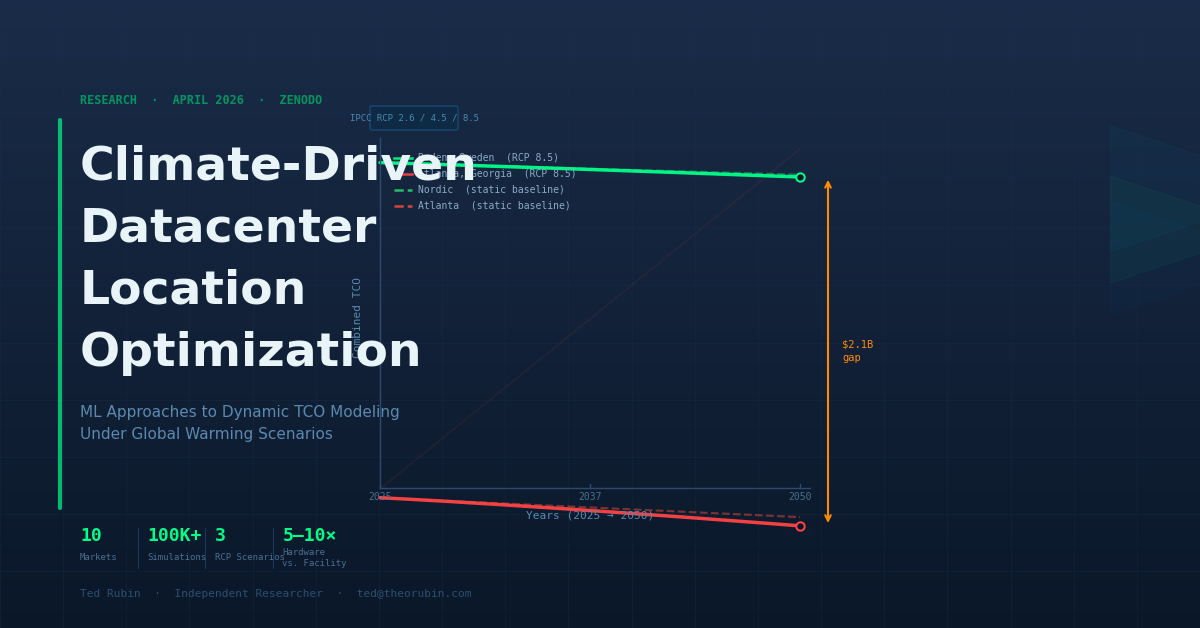
A four-part research series quantifying the full cost of AI data center deployment — from global site selection to hardware lifecycle to device-level TCO. Using Monte Carlo simulation, machine learning, and real government datasets, the research demonstrates that Nordic locations are 75% cheaper than traditional US hubs, hardware energy costs dwarf facility costs by 5–10×, and climate change compounds that gap every year through 2050. Includes full Python source code, reproducible notebooks, and supporting cost models for hardware tiers and Apple ARM devices.

 Financial-Structural Vulnerability: How Private Equity Ownership Architecture Produces Consumer Harm in Essential Services

Financial-Structural Vulnerability: How Private Equity Ownership Architecture Produces Consumer Harm in Essential Services

Consumer Protection Apr 2026

Private equity ownership of essential consumer services produces measurable harm when aggressive leverage meets weak federal oversight.

Consumer Protection Marketing Finance
Featured We Trained Neural Networks to Predict Where the ISS Will Be in 6 Hours

We Trained Neural Networks to Predict Where the ISS Will Be in 6 Hours

Orbital Mechanics Mar 2026

TL;DR: Our LSTM predicts ISS position to within 125 km at 6 hours (54.5 km at 1 hour) — 10x better than physics-based propagation. Adding solar wind data via cross-attention improves predictions by 17% during geomagnetic storms.

Machine Learning